
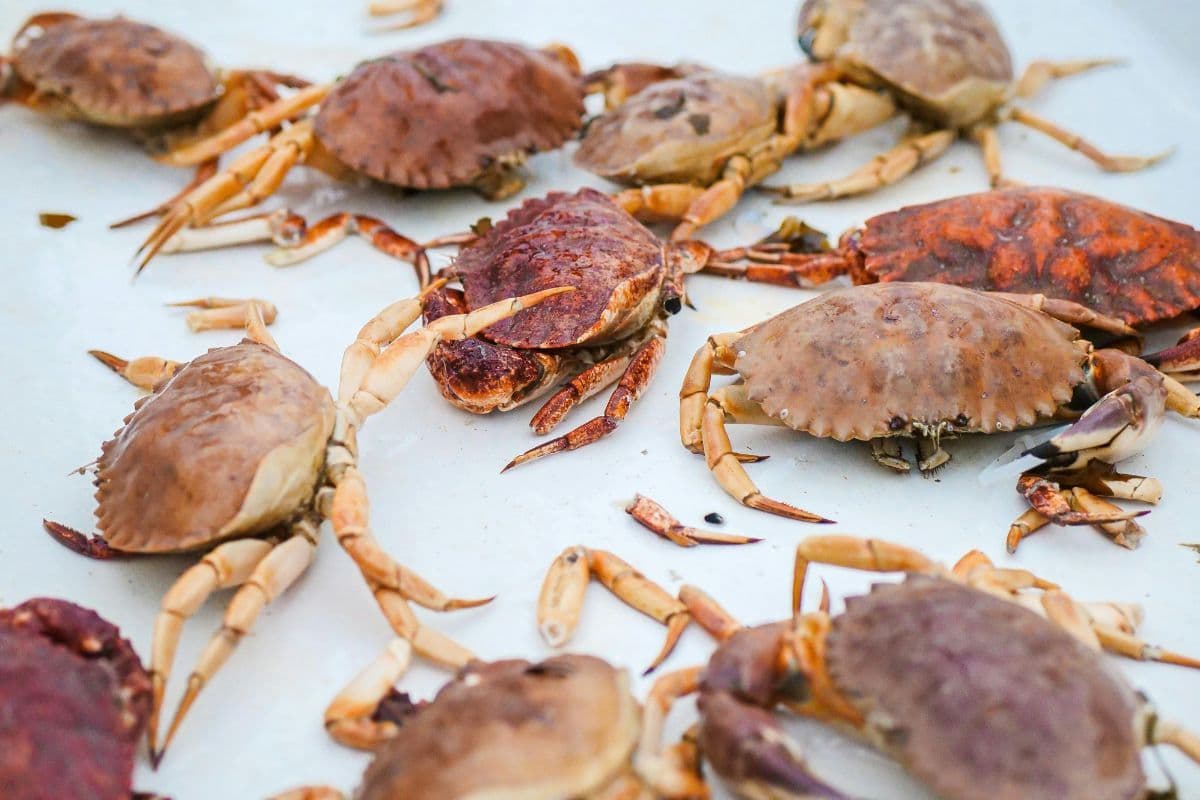
In the Northwest, crab is the species that economically supports fishing communities most of the year. Its peak production season is summer and its income amortizes the return to school of fishing families.
The main export market for Mexican crab is the United States, with a volume of 2,727 tons and a value of 39 million dollars in 2024, according to the National Oceanic and Atmospheric Administration (NOAA), a US federal agency.
However, crab exports to the United States in 2024 fell by 47% compared to 2021. This has consequences for the entire production chain in the Mexican Pacific and the Gulf of California, mainly in Sinaloa and Sonora, which in 2023 produced 76% of the national volume of this species, according to the Statistical Yearbook of the National Aquaculture and Fisheries Commission (Conapesca).
For fishermen, crab represents up to 80% of the total income of cooperatives in the area. This is the case of the Silvia Ramírez fishing cooperative, based in Agiabampo-Bacorehuis Bay in Sinaloa.
“Every year the cooperative has revenues of 15 million pesos, of that, 10 are from the sale of crab... so it is a very important fishery and we must demand how to take care of it so that it remains over time and is sustainable,” said Alfonso Chaparro, member of the Silvia Ramírez cooperative and president of the 21st Century Federation of Fishing Cooperatives, which brings together 14 Sinaloa cooperatives.
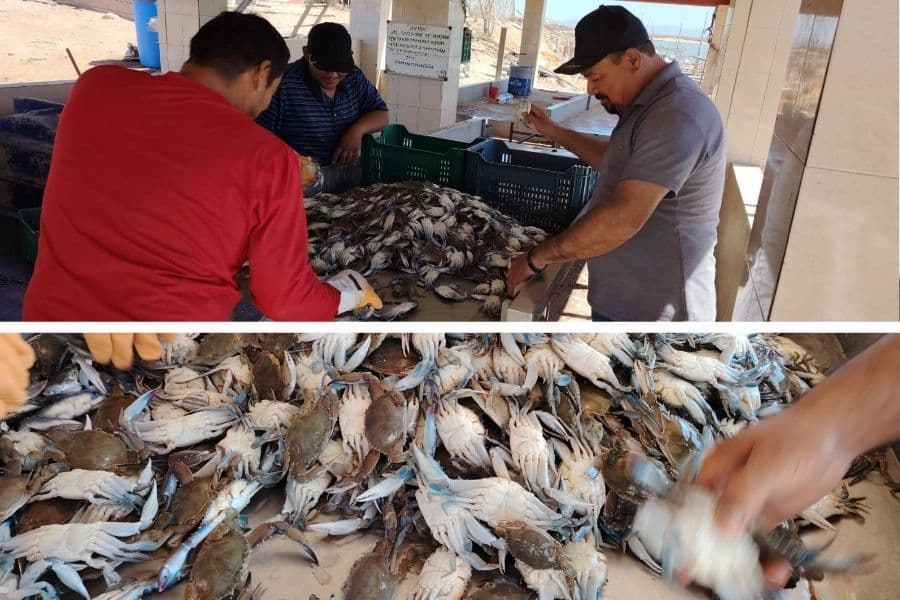 Fishermen in Agiabampo, Sinaloa disembarking crab. Source: Silvia Ramírez Cooperative.
Data from the Ministry of Agriculture and Rural Development show that 2021 recorded the lowest crab production since registration (2014-2024) and although it increased during 2022 and 2023, in 2024 production fell again by 20% compared to the previous year's production.
This is resented by fishing cooperatives, which in the last five years have noticed a reduction in crab production from 600 tons per year to 300 tons, equivalent to half of production.
“Right now there are other factors that may affect climate change, but we look and consider that for the most part what hits the resource very hard is illegal fishing,” Chaparro said.
Markets/Illegality that sabotages sustainability
Because it is considered an aphrodisiac, there is an increasing commercialization of eggs due to the demand of an Asian market, despite the fact that this is prohibited in NOM-039-PESC-203, which establishes guidelines for sustainable crab fishing in Sonora and Sinaloa.
“It's very sad when the market requires the commercialization of these products, regardless of the laws that govern them,” Chaparro said.
To obtain egg-laden females, poachers catch during the ban, which is the reproductive stage of the species. This practice has the most detrimental to crab populations in the Pacific, according to the fishermen and traders interviewed.
“The commercialization of eggs has a completely negative effect on domestic production and is a serious issue because it prevents the reproduction of the next generation of the species, which is what will feed us all,” said Mauricio Orellana, founding partner of Orca Seafood, a company dedicated to the capture, breeding, production and marketing of fish and seafood in Mexico and abroad, and a partner of Comeesca and Pesca con Futuro.
It is similar with poaching that does not meet the minimum sizes. Not being received at processing plants or for export, they enter an informal domestic market in local fishmongers and shellfish shops.
Poaching that meets the demand of the Asian market and that ends up in the informal market mainly affects those who do comply with the rules and work legally to export to the US market.
“In the end, all the damage falls on the fisherman because he is the one who carries his gasoline, goes out to sea, spends his time, his effort and returns to land with very low production or no production. But in reality, the impact is generalized to everyone, both to transport, to processing plants and to the country itself because we are not exporting volume,” said Marco Antonio Reyes of RN del Pacfico, a company established in Obregón, Sonora, dedicated to the export of crab.
Three years ago, RN del Pacfico bought about 1,500 tons of whole crab from Sonora cooperatives a year ago. However, in 2024 they did not reach 300 tons.
The United States market is a preeminent destination. Between 2018 and 2022, the neighbor to the north represented 85% of crab exports, according to the latest official data from the Agrifood and Fisheries Information Service.
Since crab became attractive to the U.S. market, fishing communities have strived to implement more rigorous management mechanisms and sustainable practices for this fishery, such as respecting fences, sizes, fishing gear and not capturing roasted females.
However, poaching undermines these efforts. While they sacrifice themselves and stop fishing during the ban, others plunder the sea. When the ban ends, the fishermen go out to sea and barely recover what they invested in gasoline and equipment.
In a context of illegality where offenders are not punished, fishermen who insist on complying with all legal and sustainability processes to export are at a competitive disadvantage against those who do not, according to Juan Manuel García, director of Responsible Fishing and Fair Trade, a company that offers its services to companies in the fishing sector to meet the demands of social and environmental responsibility that the market demands.
“At the border, despite having an entire structure and infrastructure for importing and exporting, due to corruption and malpractices, something that does not comply with the laws always ends up leaking out. There are people who import the same crab 30% cheaper without paying tariffs, without documents and they are destroying the market,” said Orellana.
Crab is the fishery imported by the United States with the highest percentage of illegal fishing (28.4%), according to a report by the United States International Trade Commission. Although it is not known how much crab is of Mexican origin, the report calls Mexico the country that exports the most illegal fishing to the United States (25% of the total value of imports).
Paper guidelines
“In the Northwest, crab has all the instruments a fishery must have to be properly managed and is therefore the most evolved area in fisheries management from a public policy perspective,” García said.
The fishery has the NOM-039-PESC-203 and the Crab Fisheries Management Plan in Sinaloa and Sonora, where the closing dates, catch sizes and fishing gear are determined.
Despite the regulations, in practice these guidelines are not respected because there is insufficient inspection and surveillance on the part of authorities such as Conapesca and the Secretariat of the Navy (Semar) to discourage these practices.
For García, there was a dismantling of the fisheries administration and of inspection and surveillance during the presidency of Andrés Manuel López Obrador and so far of Claudia Sheinbaum, with the disintegration of the budget and human resources that Conapesca went through.
Faced with this scenario, communities have taken the lead and carry out community surveillance with their own means, and there are more and more conscious processing plants and marketers that strive not to pay for illegal markets. In this regard, García believes that there has been an evolution, but more communities need to join.
“Fishing communities are in a downward spiral of social degradation as resources run out. From a social point of view, crab is very important for the well-being of communities, so there should be more interest on the part of authorities and communities in sustainable management,” said García.


Comentarios (0)